Rashid Liaquat

AI researcher, computer vision and embedded AI

I build models that help vehicles read the road. My MS AI thesis predicts unmarked speed breakers and potholes on Pakistani roads before a rider reaches them. My next focus is embedded AI, and I am open to research collaboration on it.

Get in touchEmail me

Portrait of Rashid Liaquat

Research

Umer Farooq and I work on both projects together. We each write our own thesis. The papers and products are shared, with first authorship alternating between us.

Self-Supervised Speed Breaker & Pothole Anticipation

MS thesis project, Joint work with Umer Farooq, In progress

Predicts unmarked speed breakers and potholes before impact using a phone's camera, GPS and motion sensors. Training labels come from the vehicle's own response to the road, so no manual labeling is needed.

Pipeline: Record, Detect the event, Label, Extract frames, Train, Anticipate.

Computer Vision, Self-Supervised Learning, Sensor Fusion

Details
  1. Record. Phone camera, GPS and IMU on a rigid mount
  2. Detect the event. GPS speed dip plus accelerometer spike; gyroscope confirms
  3. Label. The vehicle's response marks the bump or pothole
  4. Extract frames. Video from 2 to 3 seconds before the event
  5. Train. A lean vision model learns what the road looks like before a hit
  6. Anticipate. Warn before impact and add the spot to a hazard map
Problem
Many speed breakers and potholes on Pakistani roads are unmarked and unmapped, so drivers and navigation apps cannot see them coming.
Approach
The vehicle's own response is used as the label. A dip in GPS speed together with a spike in the accelerometer marks a road event, and the gyroscope confirms it. Video frames from 2 to 3 seconds before the event are then extracted and used to train a lean vision model that recognises the road ahead.
Data
A phone fixed rigidly to the vehicle records camera video, GPS and IMU readings (accelerometer and gyroscope). A rigid mount is required, because a gimbal would remove the vibration signal the labels depend on.
Why it matters
No manual labeling is needed, and the model learns from local road conditions instead of foreign datasets.
Status
Data collection and sensor calibration are the next steps. No results are claimed yet.
My MS thesis (in progress)
Data collection with a rigidly mounted phone, sensor calibration, self-labeling pipeline, and the vision model.
Research paper (planned)
A paper by Rashid Liaquat (first author) and Umer Farooq (second author) on self-supervised road-hazard anticipation using vehicle response as the label, aimed at a computer vision or intelligent transport venue.
Joint product (planned)
A rider or fleet safety device: a small sensor unit with a GPS hazard map that warns before known bumps, built on the thesis models.
Motorcycle-Aware Collision Warning

Joint project, Umer Farooq's MS thesis, In progress

Detection and tracking of motorcycles and rickshaws in dense traffic, with a collision warning layer on top.

Pipeline: Record, Annotate, Detect, Track, Estimate, Warn.

Object Detection, Tracking, Road Safety

Details
  1. Record. Road video from a stabilized camera
  2. Annotate. Boxes on motorcycles and rickshaws
  3. Detect. A detector finds them in each frame
  4. Track. Each vehicle keeps its identity across frames
  5. Estimate. Time to collision from distance and speed
  6. Warn. Alert when the time falls below a safe limit
Problem
Motorcycles and rickshaws weave through dense traffic and are often missed by systems built for cars and lanes.
Approach
Supervised detection and tracking of motorcycles and rickshaws, then estimation of time to collision to trigger a warning before a risky situation develops.
Data
Road video from a phone camera, annotated manually with bounding boxes. A gimbal is used to keep footage stable.
Status
In progress under Umer Farooq. No results are claimed yet.
Umer's MS thesis (in progress)
Annotated road video, detection and tracking of motorcycles and rickshaws, and time-to-collision estimation.
Research paper (planned)
A paper by Umer Farooq (first author) and Rashid Liaquat (second author) on motorcycle-aware collision warning in dense, mixed traffic, with results on locally collected data.
Joint product (planned)
A collision warning aid for riders and drivers that works in mixed traffic like Pakistan's.

Current focus

Embedded AI

My next focus is embedded AI: sensing and models that run on small, low-power hardware, right on the vehicle, without needing the internet.

Why on the device. A road warning is only useful if it arrives in time. Sending video to a server is too slow and too costly for a rider on a bike, so the model has to live on the device.

How it connects to my thesis. My thesis is built around this. Data is collected with a rigidly mounted phone, then the plan is a small sensor unit with a microcontroller, an IMU and GPS that logs rides, builds a GPS hazard map, and warns before known bumps. The vision model is kept lean so it can move onto small hardware.

Planned. Data collection comes first; hardware choices follow what the data shows.

Projects

Each notebook is open on GitHub. Figures come from the final run saved in each notebook.

Plant Disease Classification with Vision Transformer

Project, Completed

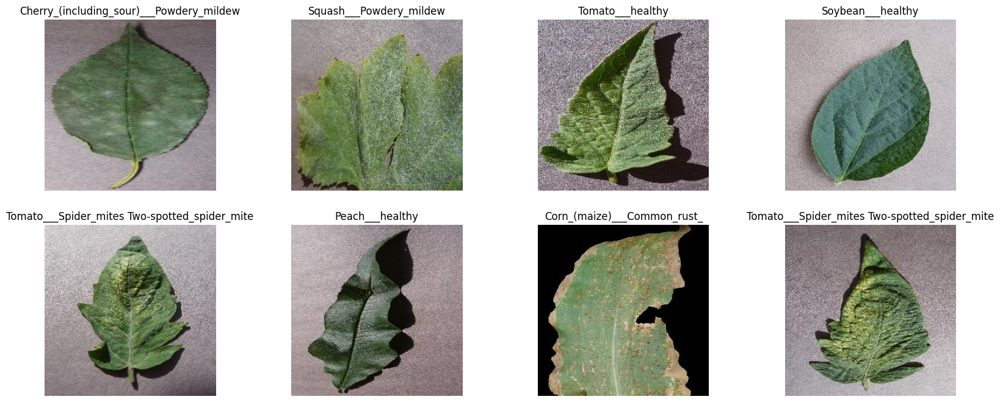
Classifies leaf images into 38 classes from the PlantVillage dataset using a Vision Transformer with transfer learning in PyTorch and Hugging Face Transformers.

92.27% validation accuracy

Vision Transformer, Transfer Learning, PyTorch

Eight sample leaf images from PlantVillage, each labeled with its plant and disease class
Sample leaves from PlantVillage, with class labels.

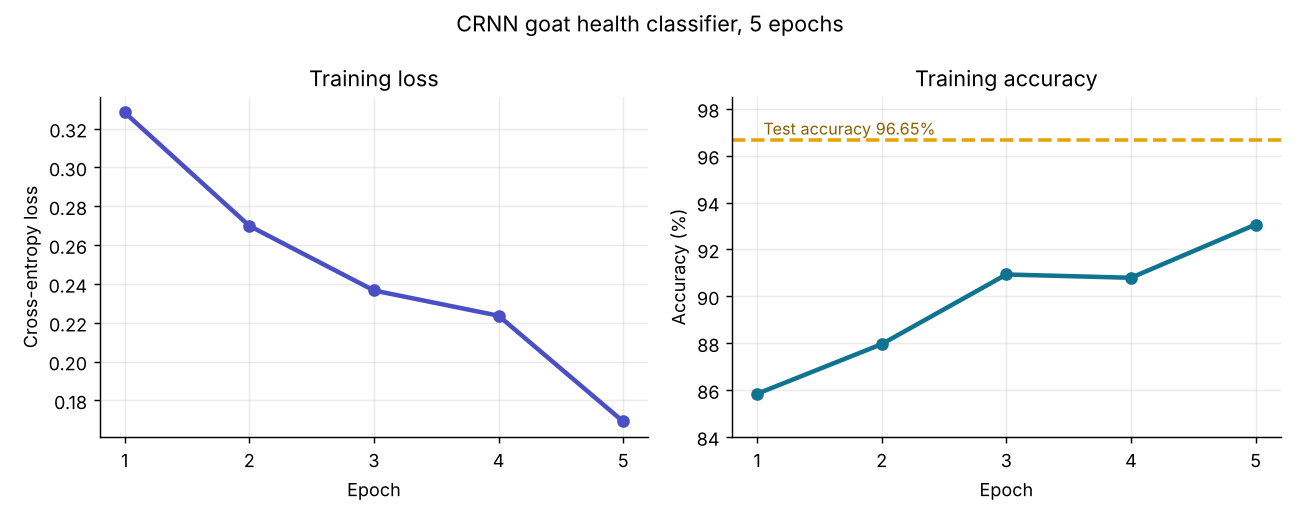
Goat Health Classification (CRNN from Scratch)

Project, Completed

Separates healthy from unhealthy goats using a CNN + LSTM (CRNN) model built from scratch in PyTorch, trained on 742 images and tested on 186.

93.06% train accuracy96.65% test accuracy5 epochs

CNN, RNN, PyTorch

Line charts of training loss falling and training accuracy rising over 5 epochs, with the test accuracy shown as a dashed line
Training loss and accuracy over 5 epochs, with the final test accuracy.

Fruit and Vegetable Classification with CNN

Project, Completed

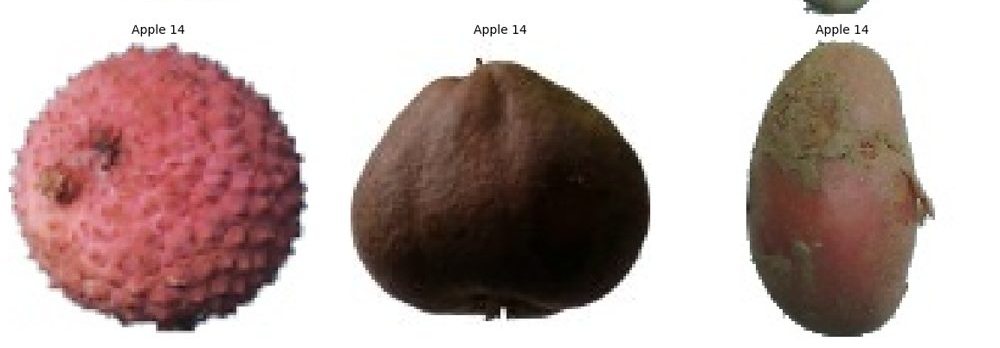
Classifies 240 fruit and vegetable classes from the Fruits-360 dataset (100x100 images) with a CNN in PyTorch.

80.51% train accuracy95.05% test accuracy5 epochs

CNN, PyTorch, Image Classification

Three sample fruit images from Fruits-360 on white backgrounds
Sample images from Fruits-360.

Exam Score Prediction with Linear Regression

Project, Completed

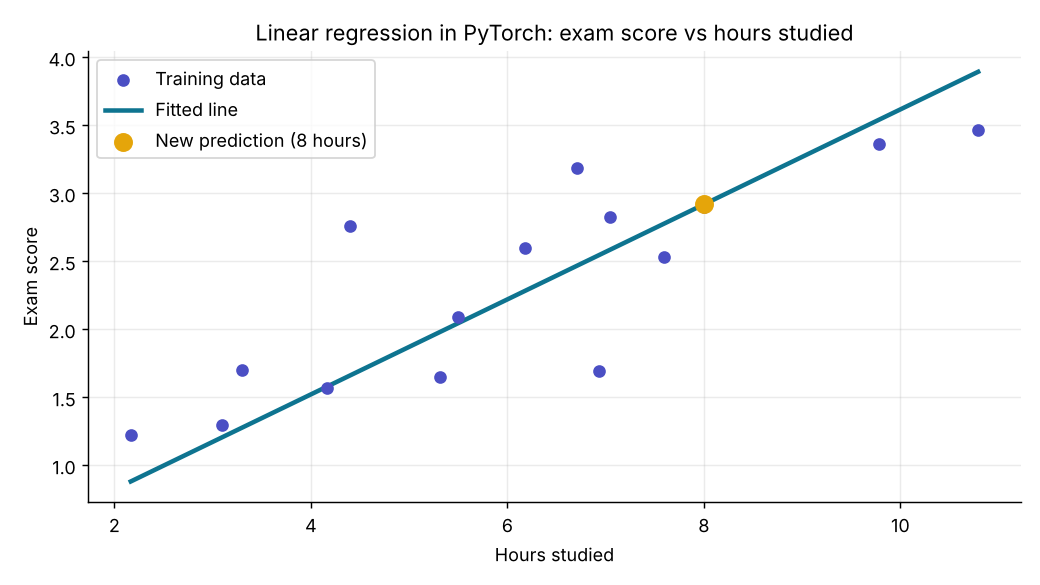
A linear regression model built in PyTorch that predicts exam score from hours studied, following the full workflow: tensors, model, loss and optimizer, training loop, evaluation, a new prediction and saving the model.

0.2197 final training loss6 epochs

Linear Regression, PyTorch, Machine Learning Basics

Scatter plot of exam score against hours studied with a fitted straight line and one new prediction
Fitted line and a new prediction for 8 hours of study. The figure is redrawn from the notebook's values.

Fashion-MNIST Classification with Logistic Regression

Project, Completed

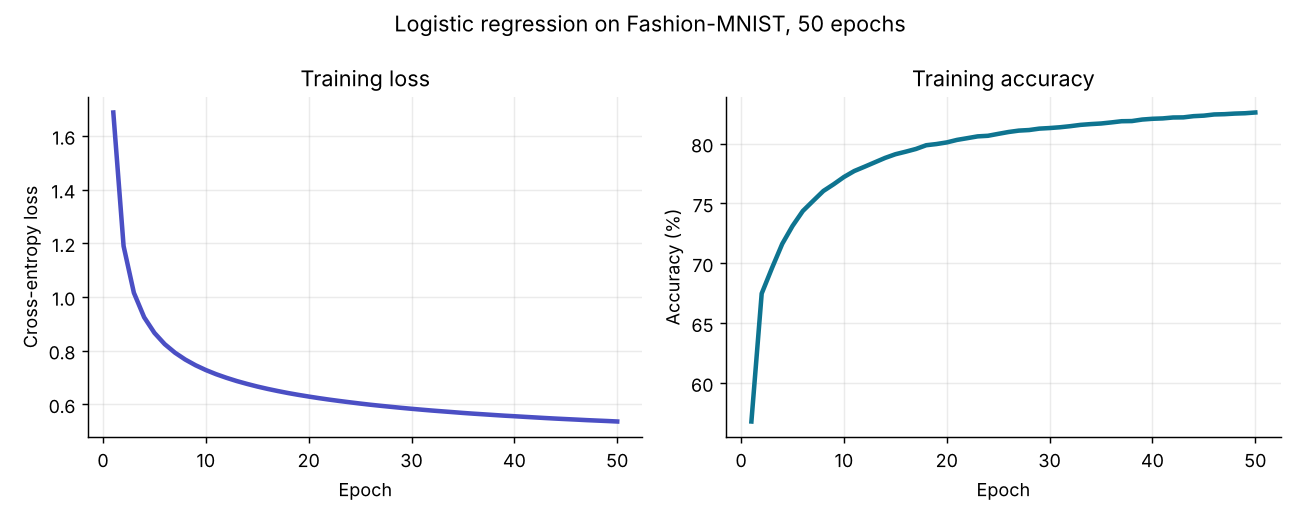
A logistic regression classifier in PyTorch that sorts 28x28 grayscale clothing images into 10 categories from the Fashion-MNIST dataset (60,000 training and 10,000 test images), trained with mini-batches and SGD.

82.60% train accuracyabout 81% test accuracy50 epochs

Logistic Regression, PyTorch, Image Classification

Two line charts showing training loss falling and training accuracy rising over 50 epochs
Training loss and accuracy over 50 epochs, plotted from the notebook's output.

Skills

Deep learning. PyTorch, CNN, RNN and CRNN, Vision Transformer, Transfer learning, Hugging Face Transformers, NLP.

Sensing and signals. GPS, Accelerometer and gyroscope (IMU), Sensor fusion, Camera geometry basics.

Tools. Python, Jupyter and Colab, Git and GitHub, Kaggle.

Currently learning. Embedded AI, Classical vision before deep learning, Model deployment on small devices.

Where I can contribute

  • Research collaboration. Joining a research team on computer vision, self-supervised learning or sensor-based road safety, from literature review and experiments to co-authoring papers.
  • Image classification prototypes. Building and evaluating CNN, CRNN and Vision Transformer classifiers in PyTorch, with transfer learning, augmentation and honest train and test reporting.
  • Sensor data experiments. Collecting and cleaning camera, GPS and IMU data, and turning it into labeled datasets with simple, checkable rules before any model is trained.
  • Experiment write-ups. Clear notebooks, figures and short reports that show what was tried, what the numbers are, and what still needs fixing.

About

I am an MS AI student at Superior University, Lahore (full name: Hafiz Muhammad Rashid). My work so far covers image classification with CNNs and Vision Transformers, and sequence models. I am now moving into sensor fusion, self-supervised learning and embedded AI for road safety.

MS Artificial Intelligence, Superior University, Lahore. Started in Fall 2025. Thesis supervisor: Dr. Arfan Jaffar (Professor, Superior University). Co-supervisor and mentor: Talha Nadeem (PhD in AI, AHOY).

Contact

I am open to research collaboration, especially on embedded and edge-based AI, and to AI and machine learning internships. If you have a project or an opening, send me a message.

Email
rashid.liaquat68@gmail.com Open in Gmail
LinkedIn
linkedin.com/in/rashid-liaquat

Message on LinkedIn